

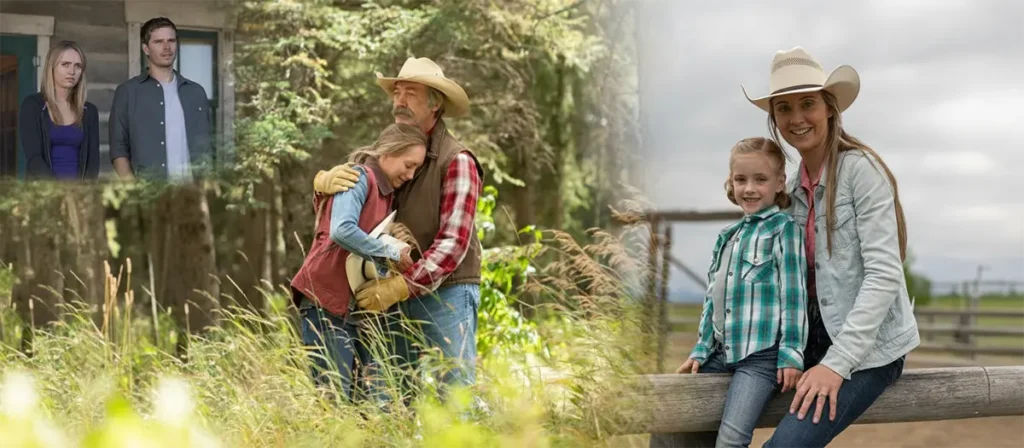
If you’ve ever told yourself you’d watch just one episode of Heartland and suddenly it’s 2 a.m. and you’re six episodes deep, this is for you. Something about that Alberta ranch, those horses, and that stubborn, tangled family keeps pulling people back in — even after nearly two decades on air.
At some point it stopped being “that horse show” and quietly became a ritual: Sunday nights, Netflix marathons, background noise while you cook, the thing you put on when real life is too loud.
The first time Heartland got under your skin
Go back to the beginning for a second.
Amy Fleming, still shaking from the car accident that killed her mom, standing in the barn with a terrified horse she’s not sure she can save. Lou trying to manage the ranch like a spreadsheet. Jack watching all of it with that face that says he’s seen worse, but he still worries anyway.
The pilot isn’t flashy. No wild twist, no big speech. Just a girl, a horse, and a family whose grief leaks out sideways — through chores, sarcasm, and bad decisions. That’s the hook. Not a perfect ranch, but a family hanging on by frayed rope… and you want to see if they can tie it back together.
Heartland premiered on CBC in 2007 and slowly grew into the longest-running one-hour drama in Canadian television, stretching across 18+ seasons and hundreds of episodes. Somewhere along the way, it turned from “something you’re trying out” into “somewhere you go back to.”
“You don’t just watch Heartland. You visit it.”
The way time works on the ranch
One of the strange gifts of Heartland is how openly it lets time pile up.
Kids actually grow up on screen. Amy shifts from gifted teen trainer to single mom, business owner, and the person everyone quietly assumes will fix whatever’s broken — animal or human. Lou cycles through careers, countries, relationships, and still ends up at that same kitchen table, arguing over coffee. Jack and Tim keep circling each other, stuck between history and something like forgiveness.
The show doesn’t rush through any of it. Loss hits, and instead of being wrapped in an episode or two, the fallout hangs over seasons. Characters drift away and come back years later, older, changed, sometimes softer, sometimes not at all.
If you’ve watched from the early seasons into the recent ones, your own life has probably shifted in the background too:
- Maybe you started Heartland as a teenager who loved the horses and now you’re watching as a parent, catching different lines.
- Maybe you dropped off around the middle seasons and returned during a hard year — grief, breakup, burnout — and suddenly Amy’s steady work with a difficult horse feels weirdly personal.
- Maybe you’re on your third rewatch and the first seasons feel like old photos: bad haircuts, simpler problems, everybody still figuring out who they are.
That’s the “Heartland memories” part. You’re not just remembering story arcs; you’re remembering who you were when you first watched them.
Comfort TV that still lets life hurt
Because Heartland is often labeled “wholesome,” it’s easy to forget how much heavy stuff the show walks through: divorce, accidents, money trouble, addiction, PTSD, sudden loss. It almost never plays those moments for shock value.
Instead, you get long scenes in the barn where nothing “big” happens, except someone finally says one true thing. You get messy apologies that don’t fix everything overnight. You get horses whose trauma mirrors their riders’, forcing people to admit what they’re actually afraid of.
That’s why so many fans keep rewatching. You know the outcomes. You know who ends up together, who leaves, who doesn’t make it. But the process — the slow, stubborn healing — still lands.
It’s comfort TV, but it doesn’t lie to you about how hard real life can get.
The little things that stick
Ask a longtime fan what they remember, and you’ll hear things like:
- The sound of the screen door at Jack’s house slamming as someone storms out — again.
- Spartan’s ears flicking back when Amy’s voice tightens, like he can feel her mood before she can.
- That wide Alberta sky, always bigger than whatever problem the family is chewing on that week.
On rewatches, other details start to glow:
- Jack’s small, hidden smiles when the younger generation accidentally proves him right.
- The way Lou’s ambition is never really the villain; it’s her fear of failing the people she loves.
- Ty’s scrappy loyalty, and how much of the show’s heart is tied to his choice to stay instead of run.
These moments add up into something like muscle memory. You know the beats of certain episodes the way you know the drive home: turn here, slow down there, brace yourself for that one curve.
How to relive the journey now
With seasons stacked on streaming and new episodes still rolling out, it’s easier than ever to jump back into Heartland almost anywhere.
If you’re thinking about a rewatch, here are a few ways to make it hit a little different:
- Pick one character and track only their arc. Follow just Amy’s big decisions, or Lou’s career shifts, or Georgie’s riding story. It makes familiar episodes feel new again.
- Revisit a specific era. Early seasons feel like raw teenage years; middle seasons play like a messy, sprawling young-adult life; recent seasons are about rebuilding and second chances.
- Watch with someone who’s never seen it. Let them be shocked by the twists you already know are coming. Their reactions will pull new feelings out of old scenes.
- Use it as your “anchor show.” In stressful weeks, keep one episode a night as a steady routine — something you can rely on when the rest of the day is chaos.
Because the series is still releasing new chapters, your memories of Heartland are still being written. The ranch changes, people drift in and out, kids become adults… but the core stays the same: horses being given one more chance, and humans trying, failing, and trying again beside them.
Maybe you just want to see Amy with a new horse. Maybe you need to hear Jack mutter one more dry line in the kitchen. Maybe you’re not ready to move on from a story that grew up alongside you.
Either way, the ranch gate is still open. The sky is still too big. And somewhere on that long gravel driveway, somebody is always coming home.