

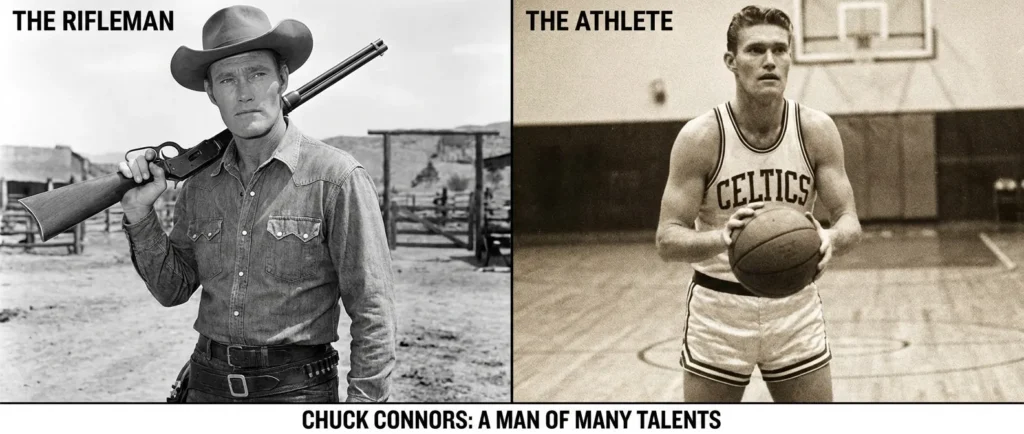
We mistook the control for calm. Lucas McCain, the moral anchor of the North Fork ranch, was defined by his precision, his self-imposed discipline in the face of frontier chaos. But Chuck Connors, the man holding the prop rifle, was a coiled, Brooklyn-born athlete whose entire life was a study in barely contained physical force.
Before the whirring of the rapid-fire Winchester became his signature sound, there was the explosion of glass. In 1946, Connors wasn’t famous; he was just a lanky 6’5″ pro basketball player for the Celtics. He wasn’t trying for a spectacle. He took a basic set shot, and the ball struck the rim with such unnatural velocity that the high-density glass backboard above him simply atomized. He became the first man in the league’s history to break a board, and he did it without the theatrics of a dunk. It was sheer, raw torque transferred from muscle through the ball, right into the structural weakness of the world. He carried that capacity for sudden, disruptive violence onto the set every day. The physical authenticity in his stunt work wasn’t acting; it was just how he moved when challenged.
This same immense physical presence, this grounded authenticity, somehow translated across the Iron Curtain. The irony of it is sharp: a show about American independence and moral clarity became one of the only pieces of US culture allowed inside the USSR. Soviet leader Leonid Brezhnev wasn’t watching the geopolitics; he was just hooked on a straight-shooting cowboy. When Connors finally went to meet him in 1973, the diplomacy turned instantly personal. Connors presented the gift—a matching set of Colt .45 revolvers. Protocol vanished. Brezhnev, the highest authority of the Soviet regime, literally leaped forward, gripping Connors in a sudden, enormous bear hug for the cameras. A Brooklyn sandlot boy, a former baseball and basketball brute, momentarily stabilized Cold War relations through a borrowed sense of heroism and a shared love of fine firearms.
Fans loved the chemistry between Lucas and Mark. The secret wasn’t a script note; it was the intense, often demanding, fatherhood Connors brought from his own life. He was a father to four sons. Johnny Crawford, who played Mark, became the fifth. Connors demanded perfection on set because he felt the show had a real obligation to model right behavior. He was notoriously strict about hitting the lines, keeping the pace, and selling the truth of a scene. But the moment the cameras cut, that demand morphed into fierce protection. He knew the grinding, consuming machine of Hollywood and the specific way it eats child actors alive. Connors used his own imposing fame and physical stature as a wall between Johnny and the vultures, standing guard against the pitfalls and the quick, toxic fame. He didn’t just perform the role of a father; he deployed fatherhood as a means of defense.
He brought the sweat of the sandlot and the shock of impact into every scene, and he demanded that same real weight from everyone around him. He didn’t just read the lines; he wore the dirt, the burden, and the guilt of necessary violence. That sound, the sudden, sharp noise of a thousand pieces of glass hitting the hardwood court, was always Chuck Connors.